Galaxy × X-ray joint fit: hot gas + AGN across BGS samples
This page documents the temperature-resolved joint fit of the galaxy × X-ray angular cross-correlation \(w(\theta)\) for the seven LS10-BGS stellar-mass threshold samples (S1–S7), combining a full-APEC hot-gas model with a duty-cycle AGN model. It covers the forward model, the emulator that makes the fit tractable, the broad-band (0.5–2 keV) results, and the energy-band (Phase B) extension that constrains the gas temperature.
The measurement is the Comparat et al. 2025 GALxEVT product (arXiv:2503.19796, zenodo:15111974): \(w(\theta) = (S^{G}_X - S^{R}_X)/S^{R}_X\) (Davis–Peebles), where \(S^{R}_X\) is the random×events background surface brightness, so the physical surface brightness is \(S_X = (1+w)\,S^{R}_X\).
Code: hod_mod.scripts.fitting.fit_xray_joint (broad band),
hod_mod.scripts.fitting.fit_xray_joint_bands (energy bands),
hod_mod.scripts.fitting.make_xray_diagnostics (figures).
Forward model
For each halo mass \(M\) the two X-ray emitters are projected onto the sky and combined with the galaxy occupation through the halo model.
Hot gas — full APEC emissivity
The X-ray volume emissivity is
with the DPM profiles (Oppenheimer et al. 2025, arXiv:2505.14782):
electron density \(n_e(r|M,z)\) — generalised NFW, amplitude \(n_{e,0.3}\) at \(0.3\,R_{200}\), mass slope \(\beta_{\rm gas}\) (this is the \(L_X\)–\(M\) scaling), outer slope set by
p2, truncated atr_max× \(R_{200}\) (GasDensityDPM);pressure \(P(r|M,z)\) → temperature \(T = P/n_e\) (ideal gas) (
PressureProfileDPM);metallicity \(Z(r)\) (
MetallicityProfileDPM).
\(\Lambda_b(T,Z)\) is the APEC band-integrated cooling function from
ApecCoolingTable (built with soxs /
AtomDB, integrating the plasma spectrum
over the energy band \([e_{\min}, e_{\max}]\)). Because \(\Lambda_b\)
depends on \(T\), the predicted \(w(\theta)\) is temperature
dependent — the physical basis of the energy-band fit below.
AGN — duty cycle
The AGN component is the duty-cycle model
(DutyCycleAGNModel): the hard-band X-ray
luminosity function (Aird et al. 2015) is K-corrected to the observed soft band and
convolved with the sample redshift kernel; the free normalisation is the duty
cycle log10DC (AGN-host fraction, prior \([10^{-3}, 0.5]\)).
From 3-D to \(w(\theta)\)
Profile FT \(\tilde X(k|M) = 4\pi\!\int_0^{r_{\max}} \varepsilon(r)\,j_0(kr)\,r^2\,\mathrm{d}r\) by Gauss–Legendre quadrature (
hod_mod.gas.conversions._profile_uk_gl()).Halo-model cross-power \(P_{gX}(k,z)\) — 1-halo (central + satellite, NFW-weighted) + 2-halo (\(b_{\rm eff}\,P_{\rm lin}\)), with the galaxy occupation from the Zu & Mandelbaum 2015 iHOD (arXiv:1505.02781) held fixed at its \(w_p+n_{\rm gal}\) MAP, the Tinker 2008 HMF (arXiv:0803.2706) + Tinker 2010 bias (arXiv:1001.3162) and Diemer & Joyce 2019 concentrations (arXiv:1809.07326) (
_pk_tables_gX()).Limber → \(C_\ell^{gX}\), then Hankel \(w(\theta) = \int \frac{\ell\,\mathrm{d}\ell}{2\pi} C_\ell J_0(\ell\theta)\), multiplied by the eROSITA King PSF window (core \(\theta_c = 8.64''\), CalDB on-axis).
eROSITA energy-conversion factor
Because the fit is to \(w(\theta)\) — a ratio that is independent of the
measurement’s fixed 1 keV/photon ECF assumption — each predicted component folds in
the true eROSITA response (TM0 survey ARF × RMF from the
eSASS4DR1 ARF/RMF page,
eROSITA DR1) via
ErositaResponse.
The emulator (making the fit tractable)
The single expensive step is the emissivity FT: at the production grid
(\(N_k = N_M = 512\), \(n_{gl}=200\)) it is a 52-million-element
\((N_k, N_M, n_{gl})\) cube, originally ≈ 5.7 s per redshift, ≈ 13 s per
angular_cl_gX call — far too slow for a 7-sample MAP/MCMC. Three changes make
it fast without changing the result:
Vectorised emissivity mass loop (
GasDensityDPM._ne_grid) — bit-exact.``np.sinc`` + ``np.einsum`` rewrite of the FT (
hod_mod.gas.conversions._profile_uk_gl()): no dense product cube, cached Legendre rule — bit-exact (\(\lesssim 10^{-10}\)), ~1.3 s/call, half the peak memory.n_glcannot be lowered (Gauss–Legendre cannot resolve the oscillatory \(j_0(kr)\) at high \(k\)).X_uk emulator —
x_uk_overrideon_pk_tables_gX()/angular_cl_gX: the raw \(\tilde X(k|M)/\Lambda_{\rm ref}\) is cached per(p2, r_max, β_gas)cell (rebuilt exactly per \(\beta\) — no post-FT tilt approximation, which only captures \(n_e^2\) and misses the \(T=P/n_e\) shift of \(\Lambda(T)\)), and the exact \((n_e/n_{e,\rm fid})^2\) density scaling is applied analytically. The override reproduces a direct call bit for bit; a fit evaluation drops from ~13 s to ~2 s (interpolation only).
The model→data gas amplitude C_total is re-anchored for the full-APEC path
on S1 (its unconstrained best-fit \(A_{\rm gas}\) ⇒ density_norm = 1), then
scaled by \(1/S^R_X\) per sample; the AGN uses the analogous c_obs_total.
Phase A — broad-band (0.5–2 keV) fit
Five shared physical parameters are fit per sample (or jointly):
log10_ne_03 (density normalisation), beta_gas (\(L_X\)–\(M\)
slope), p2 (outer slope), r_max (extent), log10DC (AGN duty cycle).
The MAP uses multi-start Nelder–Mead; posteriors use emcee (64 walkers).
Run with:
HOD_MOD_RESULTS=$HOD_MOD_RESULTS JAX_PLATFORMS=cpu python -m \
    hod_mod.scripts.fitting.fit_xray_joint --samples S1 --mcmc
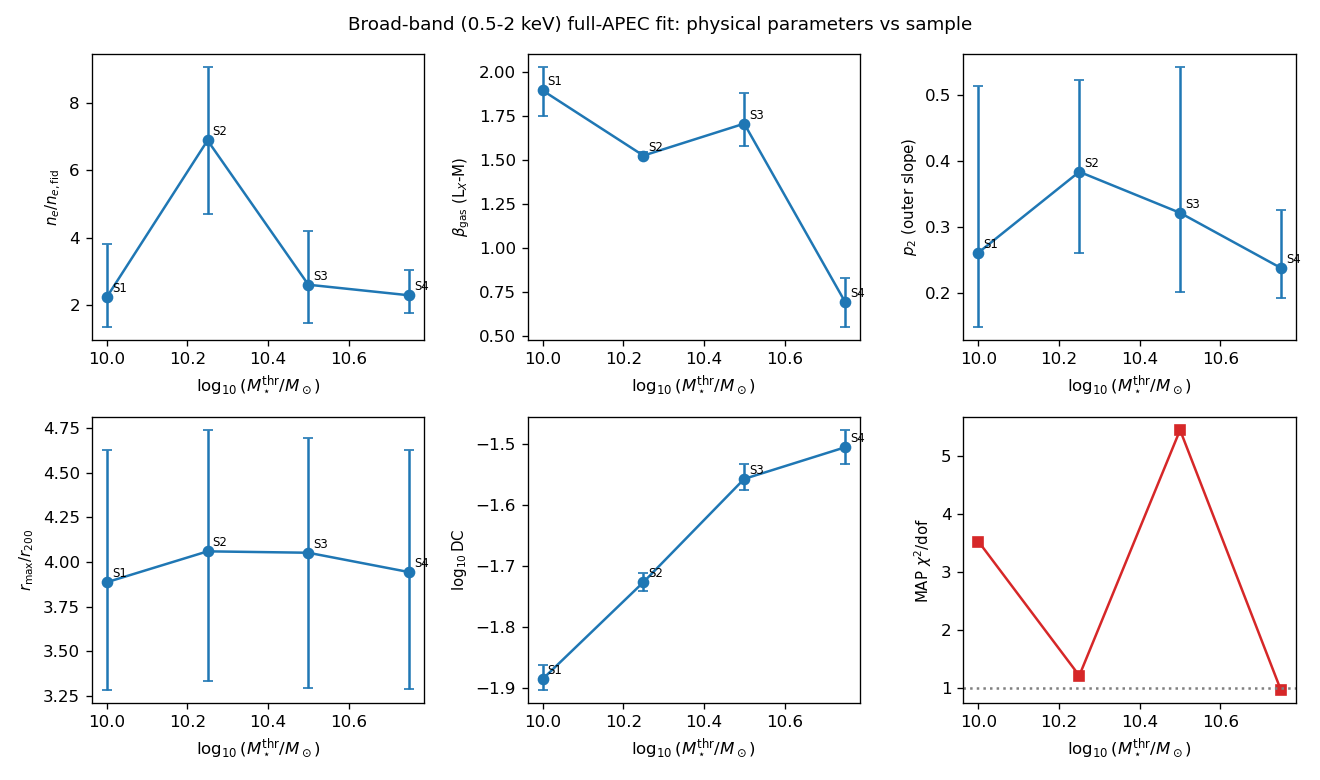
Posterior physical parameters vs stellar-mass threshold (S1–S4). The AGN duty cycle increases monotonically and tightly with stellar mass (\(\log_{10}\mathrm{DC}: -1.89 \to -1.51\)), a clean physical trend. Gas parameters are noisier and the MAP \(\chi^2/\mathrm{dof}\) is uneven (S2, S4 good; S1, S3 poor — see below).
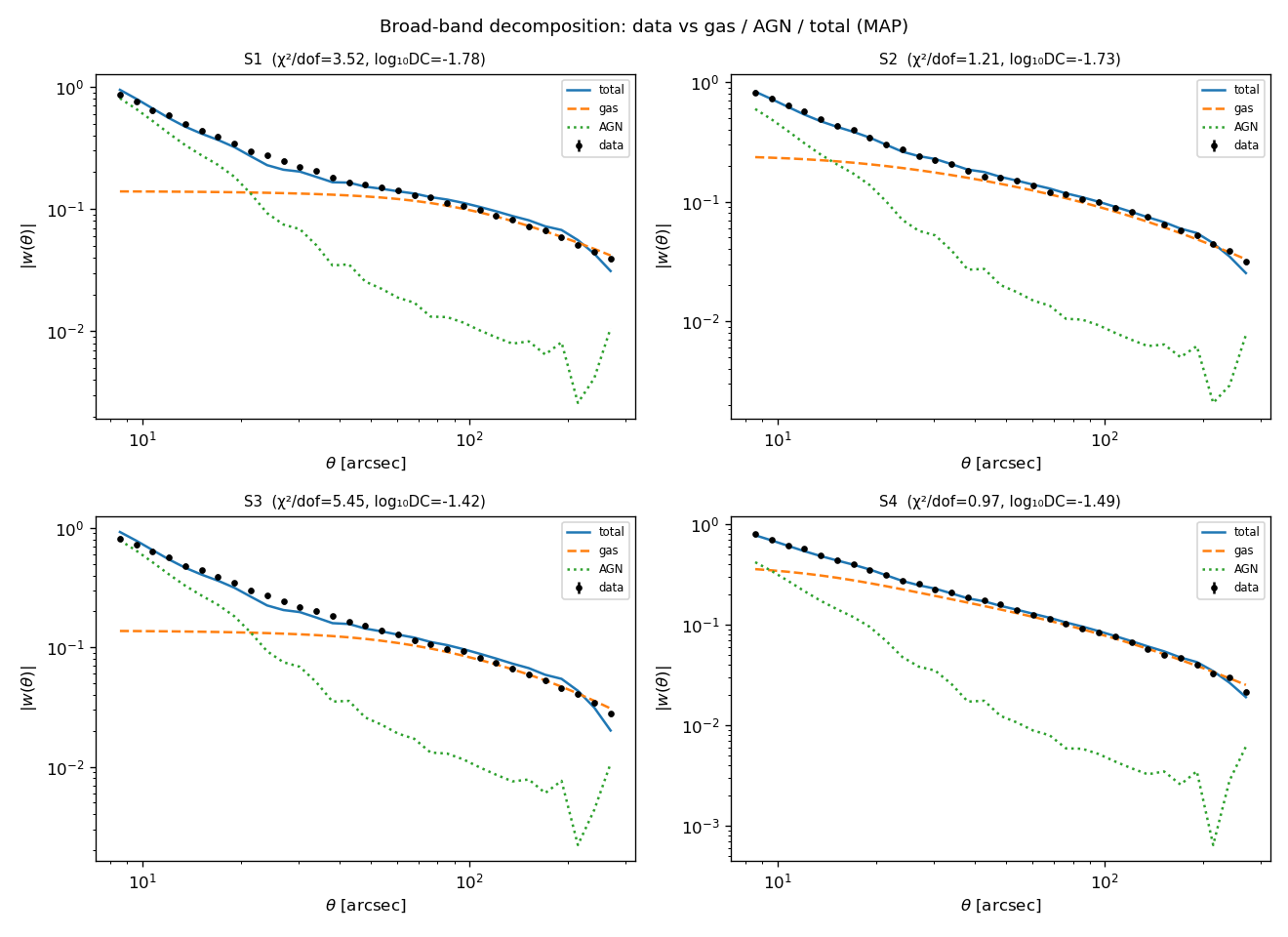
Data vs the gas / AGN / total decomposition at the MAP. The AGN dominates the small-scale (\(\lesssim 30''\)) signal and the gas the large scales.
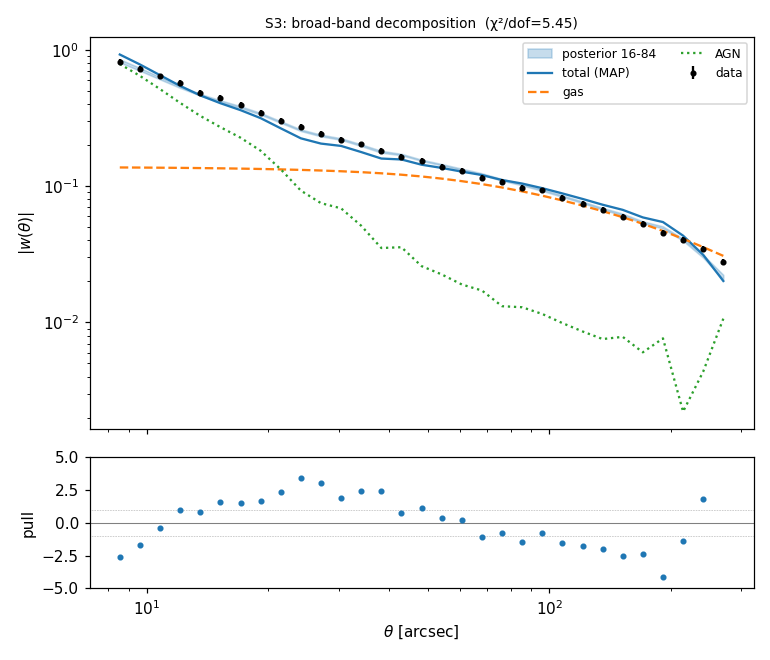
S3 residuals (pulls). A coherent \(+/-\) oscillation across \(\theta\) — a systematic model-shape mismatch at the gas→AGN “knee” (\(\sim 20\text{--}50''\)), not statistical scatter. With only the broad-band integrated signal the two components are degenerate, so for S1/S3 the MAP leaves this wiggle. This degeneracy is what the energy bands break.
Phase B — energy bands (gas temperature)
The signal is measured in 15 narrow bands (0.5–0.6 … 1.9–2.0 keV, 0.1 keV steps). The gas is thermal — its band ratios encode \(\Lambda_b(T)\) — while the AGN is a near power law, so the bands separate gas from AGN spectrally and constrain \(kT\).
Data — reconstructed from the per-field measurements with
hod_mod.scripts.fitting.reconstruct_band_wtheta(Landy–Szalay merge over the eROSITA-DE fields; validated: \(\Sigma\)(15 bands) matches the zenodo broad band to 0.4–3.3 %).Model — all 15 bands share \(n_e, T, Z\) and the FT geometry, so
emissivity_full_uk_bands()computes them in ONE batched FT (the \(j_0\) cube is reused; bit-exact vs looping single bands). The fit adds a temperature normalisationkT_norm(grid axis) to the Phase-A shape parameters (hod_mod.scripts.fitting.fit_xray_joint_bands).
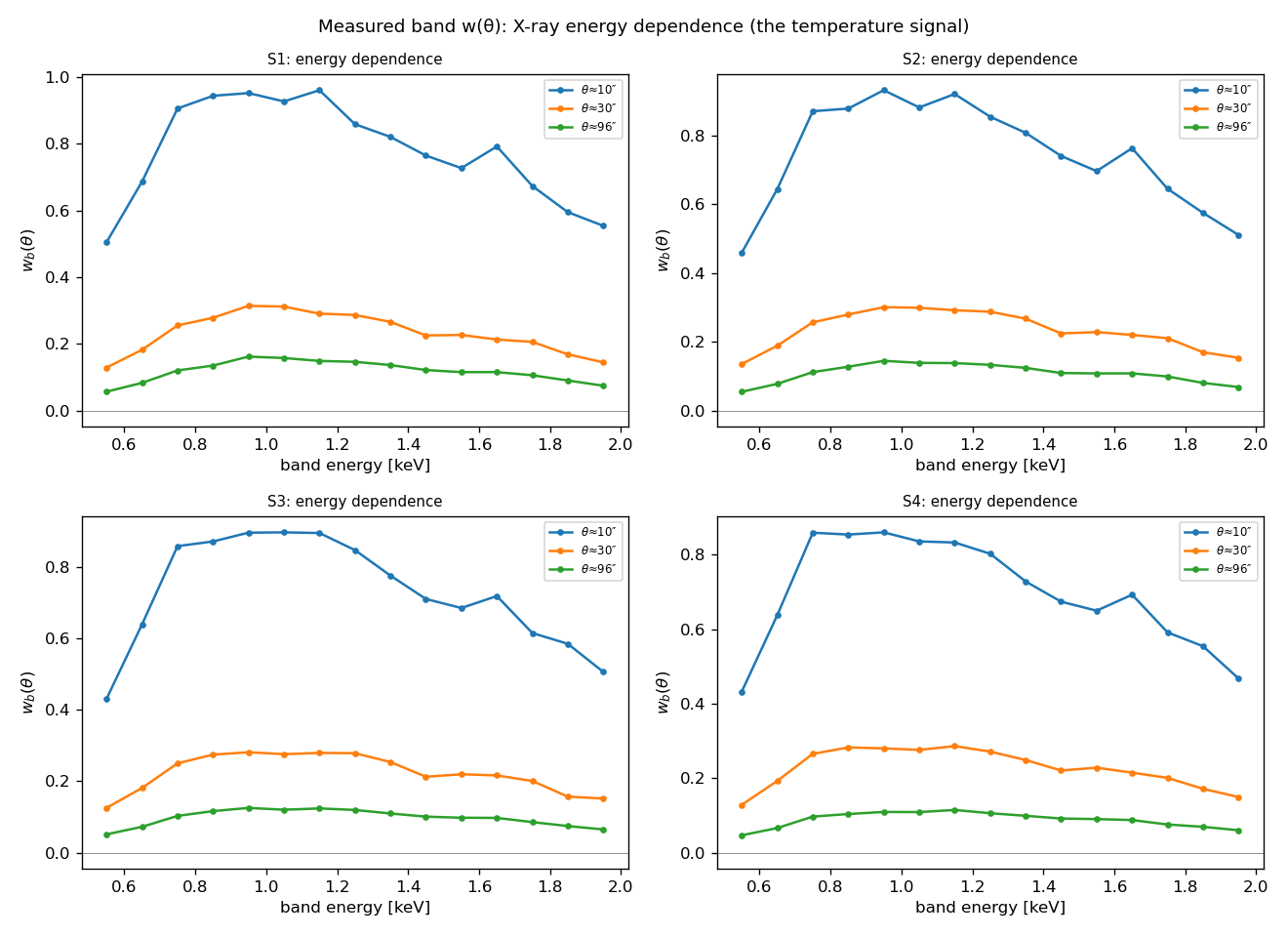
Measured band \(w_b(\theta)\) vs X-ray energy at three angular scales — the energy dependence (peaking near 0.9–1.0 keV) that carries the temperature information.
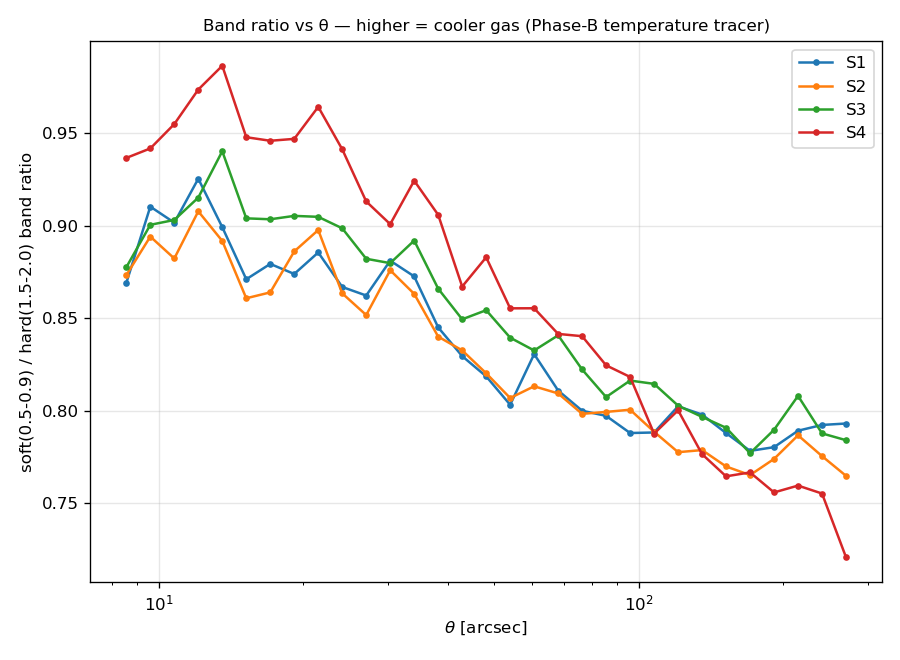
Soft/hard band ratio vs \(\theta\) — a direct, model-independent gas-temperature tracer (higher ratio = cooler gas).
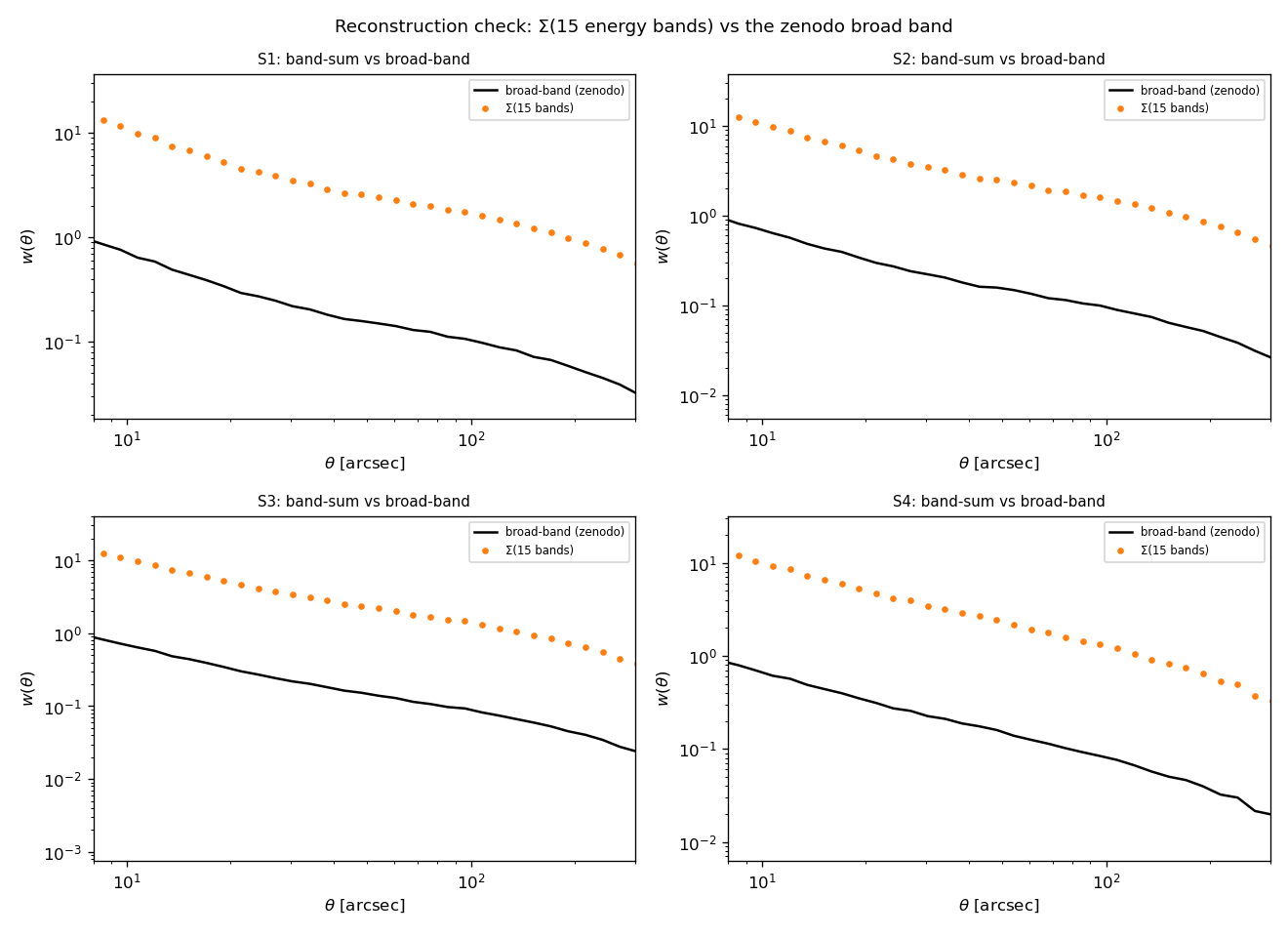
Reconstruction check: \(\Sigma\)(15 bands) vs the zenodo broad band.
Data & results layout (environment variables)
All paths resolve through hod_mod.paths (no hardcoded paths):
Helper |
Env var |
Holds |
|---|---|---|
|
|
|
|
|
emulator caches, chains, figures |
|
|
|
Reconstruct the band data ($HOD_MOD_DATA_DIR/xray_bands/<basename>/), then:
JAX_PLATFORMS=cpu python -m hod_mod.scripts.fitting.reconstruct_band_wtheta
JAX_PLATFORMS=cpu python -m hod_mod.scripts.fitting.fit_xray_joint_bands \
    --samples S1 S2 S3 S4 --map-only
JAX_PLATFORMS=cpu python -m hod_mod.scripts.fitting.make_xray_diagnostics
References
Comparat et al. 2025 — GALxEVT BGS × eROSITA (arXiv:2503.19796; data zenodo:15111974)
Oppenheimer et al. 2025 — DPM gas profiles (arXiv:2505.14782)
Zu & Mandelbaum 2015 — iHOD (arXiv:1505.02781)
Tinker et al. 2008 HMF (arXiv:0803.2706); Tinker et al. 2010 bias (arXiv:1001.3162)
Diemer & Joyce 2019 concentrations (arXiv:1809.07326)
eROSITA DR1 (erosita.mpe.mpg.de/dr1) and the eSASS4DR1 ARF/RMF
APEC / AtomDB via soxs