Tier-2 forecast: nothing fixed (90 parameters)
The tier-1 studies ask what a Stage-IV survey combination measures when the model keeps its historically fixed nuisance shapes. The tier-2 study asks the harder question the pipeline was built for:
With an optimistic end-of-decade data scenario, how much cosmology and how much astrophysics do we learn when *nothing* is fixed?
Every parameter the forward model contains is free — the 31-entry tier-1
vector, the 16 formerly hard-coded nuisance shapes that
Sensitivity study: differentiable pipeline, scale cuts and degeneracy breaking flagged as “parameters that could be freed”, 7
redshift-evolution slopes, and 7 X-ray spectral parameters enabled by energy
bands: 61 in the original tier-2 design. The
missing-physics extension has since appended 29 more
(the CPL dark-energy pair \(w_0, w_a\) and \(\sum m_\nu\); the
star-forming/quenched split and continuous sSFR sector; the cold-gas/HI
sector; SN/wind energetics; and the radio-loud, X-ray–radio and infrared AGN
channels), so the production run frees 90 parameters. The only pinned
entry is the retired log10DC duty cycle: with the Powell AGN chain
providing the point-source emission (agn_emission="powell"), the duty
cycle leaves the emissivity entirely and its only remaining consumer is the
optional energy-closure mode.
Reproduce with:
JAX_PLATFORMS=cpu python -m hod_mod.scripts.forecasts.run_tier2_forecast \
    --rmin 0.1 0.5 2.5 --n-bands 6 \
    --split-sfq --include-radio --include-hi --include-ssfr --include-ir
# fast end-to-end check (2x2 cells, tiny grids, ~2 min):
JAX_PLATFORMS=cpu python -m hod_mod.scripts.forecasts.run_tier2_forecast --smoke
The parameter vector (61 → 90)
The vector grows append-only from the tier-1 layout (indices 0–30 unchanged),
so every tier-1 script keeps working — they pin the extension
(TIER2_EXTENSION) to its fiducials by
default and grow a --free-tier2 flag.
Promoted nuisances (16). Satellite HOD shape (
beta_sat, bcut,
beta_cut, alpha_sat
), baryon-sector shape (beta_b, log10_M_eta, beta_eta), gas emissivity slopes (alpha_in_gas, alpha_tr_gas), the A10 pressure shape (p0_pressure, c500_pressure, gamma_pressure, alpha_pressure, beta_out_pressure) and the Powell “Model 2” internals (agn_rho, agn_sig_mstar). Each fiducial equals the former constant, so the fiducial prediction is bit-identical to tier-1 (this is tested).Redshift-evolution slopes (7 + 2). Additive on the base parameter per \(\ln[(1+z_{\rm eff})/(1+z_{\rm pivot})]\) with \(z_{\rm pivot}=0.3\) (
ForwardModel._theta_eff): the SHMR (lg_m1h_zs, lg_m0star_zs, sigma_lnmstar_zs), departures from the hard-coded self-similar \(E(z)^2\) / \(E(z)^{2/3}\) scalings (lx_zs, kt_zs), the AGN sector (agn_log10_ferdf_zs, agn_log10_lstar_zs, agn_mu_bh_zs) and the ICM metallicity (z_gas_zs). One shared vector drives every cell; the chain rule guarantees \(\partial d/\partial({\rm slope}) = \ln[(1+z)/(1+z_p)]\;\partial d/\partial({\rm base})\) exactly (tested to \(10^{-10}\)).X-ray spectral sector (7). See the band layer below:
t_prof_slope(radial temperature profile; 0 = the production isothermal convention),z_gas_norm, z_gas_mslope, z_gas_zs(ICM metallicity and its mass/z slopes; fiducial the DPM \(Z(0.3R_{200})=0.3\,Z_\odot\)),agn_gamma(photon index, fiducial 1.8) andagn_fabs(obscured fraction at \(N_H=10^{22}\) cm\(^{-2}\)).Missing-physics additions (29). Documented on the What the model does not yet contain page: extended cosmology (
w0, wa, sum_mnuvia the CPL growth ODE), the SF/quenched split + continuous sSFR + [OII] sector (log10_Mq_cen, mu_q_cen, log10_Mq_sat, mu_q_sat, dlx_quenched, ssfr_ms_norm, ssfr_ms_slope, ssfr_ms_zs, dssfr_q, sigma_ms, loii_norm), the cold-gas sector (log10_M0_hi, log10_Mmin_hi, alpha_hi, dhi_quenched), SN/wind energetics (eps_sn, eta_w_norm, alpha_w), and the AGN radio/IR channels (agn_xi_rx, agn_xi_rm, agn_b_r, agn_sig_r, f_loud0, beta_loud, b_jet, agn_bc_ir).Not freed, deliberately. The bolometric correction (exactly degenerate with
agn_mu_bh— both shift the L_X zero point),f_b_min(a test-reserved limiting parameter), the radial metallicity shape (DPM-fixed; a documented extension), and baryon-sector z-slopes (they would need the evolution mapping inside the wide-z lensing line-of-sight integrals).
The (z, M*) cell grid
Volume-limited galaxy samples tile the plane: \(\Delta z = 0.1\) shells
over \(0<z<1\) × 0.2-dex stellar-mass bins over \(10.0 \le \log_{10}
M_* \le 11.6\) — 80 cells. A bin sample is the exact difference of two
ZM15 threshold occupations, \(N^{\rm bin} = N(>M_{*,\rm lo}) -
N(>M_{*,\rm hi})\), each satellite term with its own threshold-derived cutoff
masses; the binned count density is the stellar-mass-function datum, so
smf is not a separate observable. In the production run every cell is
further split into a star-forming and a quiescent sample (--split-sfq) —
160 samples over the 80-cell grid. Per cell the forecast predicts
(wp, ds, cl_gX × bands, cl_gy, cl_gkCMB, n_gal) plus the main-sequence
sSFR and SFR-density data (--include-ssfr); per shell (M*-independent)
the soft-band AGN XLF, the band X-ray autos cl_XX, and the radio,
[OII] and AGN-infrared luminosity functions (--include-radio/-ssfr/-ir);
the HI mass function and 21cm×galaxy crosses at low z (--include-hi);
globally the tomographic shear block; plus the AGN clustering samples.
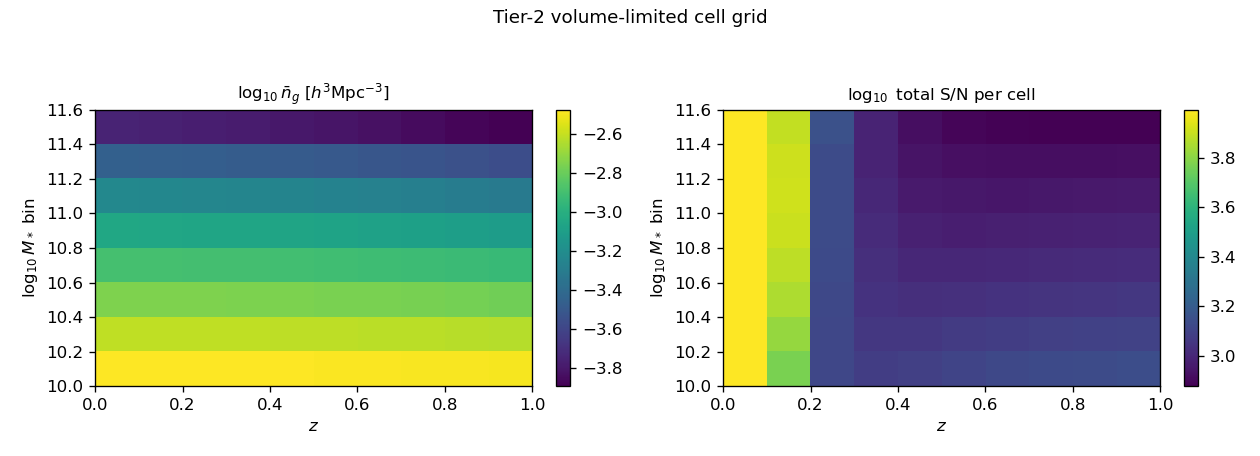
Fiducial galaxy density and the total signal-to-noise per (z, M*) cell.
This grid is what pins the galaxy–halo connection and its evolution: with 8 mass bins per shell the SHMR shape is measured within each shell, and the 10 shells then separate the base parameters from their z-slopes.
Optimism flag
“Volume-limited to \(M_*=10^{10}\) at \(z=1\) with spectroscopic redshifts over \(f_{\rm sky}=0.5\)” is beyond any single funded survey; it is the stated optimistic premise of this tier (DESI/4MOST-like coverage extended by Euclid/LSST photometry).
The AGN program and the Athena premise
The AGN sector is fully forward-modeled by the Powell chain (SHMR → \(M_{\rm BH}\)–\(M_*\) → ERDF), so the X-ray-selected AGN sample adds three independent handles:
the z-resolved soft XLF (7 points per shell, 0.5-dex bins over \(42 \le \log_{10} L_X \le 45\)), now including the hard→soft conversion \(k_{\rm h2s}(\Gamma)\) and the two-component obscuration mixture (a fraction
agn_fabsdimmed by the \(N_H=10^{22}\) MM83 transmission);the projected clustering
wp_agnof complete L_X-bin samples (0.5-dex bins above \(10^{42}\) erg/s at five redshifts) — a Bernoulli central occupation has no self-pairs, so the prediction is the clean 2-halo \(b^2_{\rm AGN}(L_X, z)\,P_{\rm lin}\). The bias per luminosity bin measures the width \(\sigma_{lm}\) of the L_X–halo relation (an abundance-vs-bias split the XLF alone cannot do). Honest finding of the production run: becauseagn_rho,agn_sig_mstarandagn_sig_bhenter this kernel only through \(\sigma_{lm} = \sqrt{\alpha_{\rm BH}^2\sigma_{M_*}^2(1-\rho) + \sigma_{\rm BH}^2}\), the X-ray probes alone leave the three internally degenerate (in the original 61-parameter runagn_rhostayed prior-bound, σ = 0.49 vs prior 0.5). The 90-parameter production run adds observables outside the kernel — the X-ray–radio correlationagn_xi_rxsector and the AGN infrared LF — which shrink the individual σ’s dramatically (agn_rho: σ = 6.6×10⁻³), yet the pairwise correlations of the triple remain ±1.000: the flat direction is narrowed, not opened. A direct M_BH census or halo-mass-resolved AGN fractions would still be the clean way to break it;the point-source term in every band
cl_gX/cl_XX, tied to the same parameters (the tier-1 \(L\propto M\) surrogate is retired together withlog10DC).
The hypothetical Athena all-sky survey is specified by one clean premise: its flux limit \(F_{\rm lim}(0.5\!-\!2\,{\rm keV}) = 2\times10^{-16}\) erg/s/cm² is exactly the depth that makes the \(L_X > 10^{42}\) sample complete to \(z = 1\) (\(L_{\rm lim}(z{=}1) \simeq 1.0\times10^{42}\) erg/s; the driver prints the check and assigns infinite noise to any (z, L_X) bin below the limit). The implied all-sky depth is \(t\,A_{\rm eff} = n_{\rm det}\bar e/F_{\rm lim} \approx 8\times10^{7}\) s·cm². The 5″ HEW PSF enters through source detection and confusion — i.e. through the XLF and the completeness argument — not through the \(\ell \le 3000\) band spectra, where the beam is unity for both 5″ and 30″.
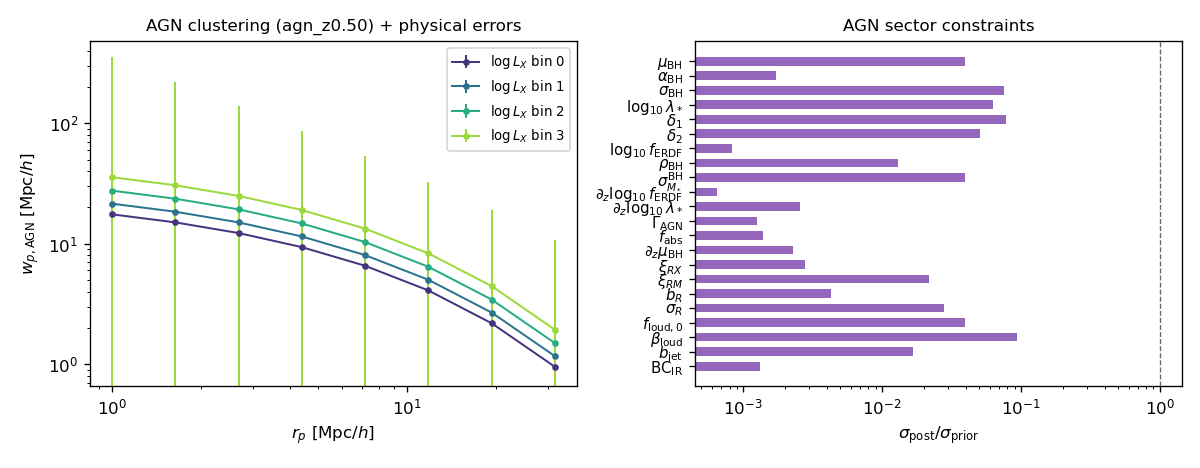
AGN clustering per L_X bin with its pair-count errors, and the AGN-sector parameter constraints.
The multi-band APEC layer
The tier-1 gas model was spectrally blind: one broad band, isothermal halos, a
crude \(kT^{0.25}\) band weight, and no metallicity anywhere. Tier-2
attaches the production band machinery (the validated
fit_xray_joint_bands 15×100 eV convention) to the differentiable model:
with \(\Lambda_b(T, Z)\) band-integrated APEC tables distilled once into
hod_mod/data/apec_bands/ (hod_mod.forecast.apec_bands) and
bilinearly interpolated in JAX — no emulator is needed because the tables
are precomputed and the interpolation is exactly differentiable. The
amplitude convention keeps lx_norm as the total 0.5–2 keV luminosity and
partitions it by emission-weighted band fractions with
\(\sum_b w_b = 1\) exact by construction; since APEC bands are additive
pointwise (\(\sum_b \Lambda_b = \Lambda_{\rm broad}\)), the band stack
sums to the broad-band prediction even with a temperature profile (tested).
The default is 6 bands over 0.5–2 keV (--n-bands {1,6,15}).
Band ratios are the new information: a temperature profile tilts soft
against hard bands with radius (the t_prof_slope derivative changes sign
across bands — tested), metallicity moves the line-dominated bands through
\(\Lambda_b(T,Z)\), and the AGN spectral shape moves all bands coherently
through \(f_b(\Gamma)\) and the absorption survival
\((1-f_{\rm abs}) + f_{\rm abs}t_b\).
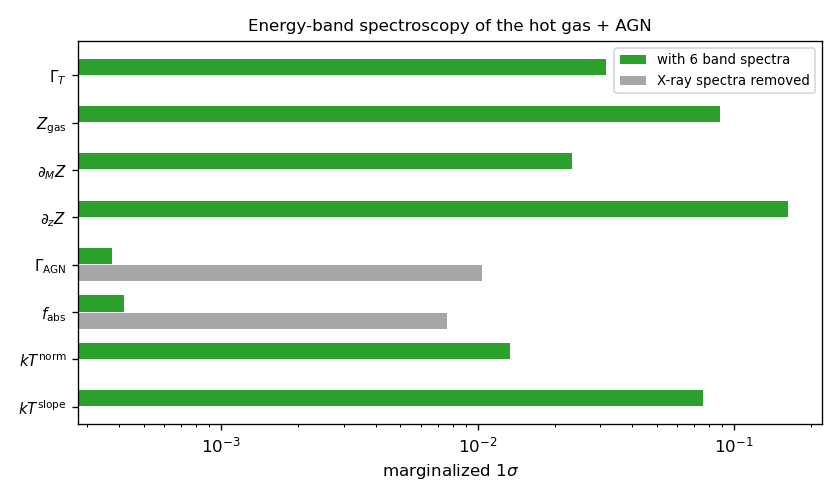
What the energy bands buy: spectral-parameter constraints with and without the band spectra.
The noise model
All errors are physical (hod_mod.forecast.noise), replacing the tier-1
effective (rN, aN) recipe:
Observable |
Noise |
Survey |
|---|---|---|
|
pair counts \(\sigma = 2\pi_{\max}(1+w_p/2\pi_{\max})/\sqrt{N_{\rm pair}}\) + cosmic variance \(\propto V^{-1/2}\), with the cell’s own model \(\bar n_g\) and volume |
DESI/4MOST-like, \(f_{\rm sky}=0.5\) |
|
shape noise \(\sigma_e\langle\Sigma_{\rm crit}^{-1}\rangle^{-1}/\sqrt{n_{\rm src}^{\rm eff}A_{\rm ann}N_{\rm lens}}\), sources at \(z_s > z_l + 0.1\) (high-z cells go noise-dominated automatically) |
Euclid+LSST, 30 arcmin⁻², \(\sigma_e=0.26\) |
|
Knox with per-bin \(N_\kappa = \sigma_e^2/\bar n_i\), 5 equal-number Smail bins with photo-z mixing |
Euclid+LSST, \(f_{\rm sky}=0.5\) |
|
Knox with flat \(N_L^{\kappa\kappa} = 7\times10^{-9}\) |
S4-like, \(f_{\rm sky}=0.4\) |
|
CXB photon noise \(N_b = I_{{\rm CXB},b}\bar e_b/(tA_{\rm eff}\,{\rm conv}^2\Delta\chi)\) per shell + galaxy shot \(1/\bar n_{\rm 2D}\); PSF beam (≈1 here) |
Athena all-sky, \(f_{\rm sky}=0.65\) |
|
Poisson \(1/\sqrt{\Phi V \Delta\log L_X}\) + the completeness cut \(L_{\rm lo} \ge L_{\rm lim}(z_{\rm hi})\) |
Athena × spec-z overlap, \(f_{\rm sky}=0.5\) |
|
pair counts with the model’s own \(\bar n_{\rm AGN}(L_X, z)\) |
Athena × spec-z overlap |
|
the calibrated stage-4 recipe (kept in v1) |
SO/ACT/SPT-like, \(f_{\rm sky}=0.3\) |
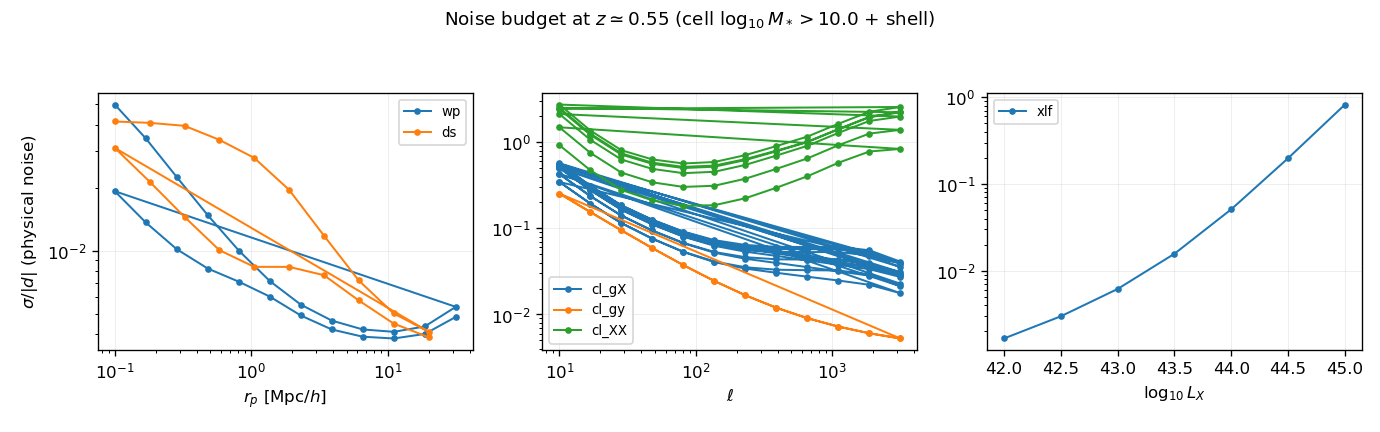
Relative errors for a representative mid-z cell and its shell.
Results: cosmology vs astrophysics
The headline deliverable is the decomposition. For every scale cut the driver reports (i) the cosmology block marginalized over all 81 astrophysical parameters vs the same data with astrophysics pinned — the cost of honesty; (ii) each astrophysics sector marginalized vs cosmology externally pinned — what the data teach about galaxies, gas and black holes independent of the cosmological application; and (iii) the information gained per sector in bits, \(\tfrac12\log_2\det C_{\rm prior}/\det C_{\rm post}\).
Headline numbers of the production run (6 bands, \(R_{\min}=0.1\) Mpc/h, 22,539 data rows, all 90 parameters free):
Cosmology is cheap to keep honest. \(\sigma(\Omega_m) = 1.8\times10^{-4}\) (0.06%), \(\sigma(\sigma_8) = 2.9\times10^{-4}\) (0.04%), \(\sigma(S_8) = 1.8\times10^{-4}\) — only factors 2.3 / 2.4 / 1.4 above the astrophysics-pinned limit. The optimistic data scenario pays for full marginalization: the cumulative build-up gives \(\sigma(\Omega_m)\) = 3.1 → 2.7 → 1.9 \(\times10^{-4}\) for the galaxy grid → +lensing → +X-ray/tSZ; the AGN probes and the new radio / IR / HI legs add little to cosmology (their value is the astrophysical sectors themselves). The extended-cosmology block is measured alongside: \(\sigma(w_0) = 3.2\times10^{-3}\), \(\sigma(w_a) = 1.4\times10^{-2}\), \(\sigma(\sum m_\nu) = 3.2\times10^{-5}\) eV (growth-only, EH98 shape — see the caveats).
Astrophysics dominates the information budget: 178 bits in the SHMR sector, 153 in the gas, 149 in the SF/quenched sector, 127 in the baryon sector, 35 in the cold-gas sector, versus 71 in cosmology (the AGN-sector determinant is singular — the \(\sigma_{lm}\) triple below — so its bits are not well-defined). Redshift evolution — inaccessible to tier-1 — is measured at \(\sigma(\partial_z \lg M_1) = 1.4\times10^{-3}\) per \(\ln(1+z)\), and the departure from self-similar L_X evolution at \(\sigma(\rm lx\_zs) = 5.4\times10^{-3}\) dex.
The energy bands work as spectroscopy: \(\sigma(\Gamma_{\rm AGN}) = 3.8\times10^{-4}\), \(\sigma(f_{\rm abs}) = 4.2\times10^{-4}\) (their correlation drops from +1.000 with one broad band to +0.94 with six), \(\sigma(\Gamma_T) = 0.032\) for the temperature-profile tilt, and the ICM metallicity is recovered to \(\sigma(Z) = 0.09\,Z_\odot\) with its mass slope to 0.023 dex/dex and its redshift slope to 0.16 dex per \(\ln(1+z)\) — though the three metallicity parameters remain almost perfectly internally correlated (±1.000). The 1-band control run (
--n-bands 1, kept in the original 61-parameter configuration) makes the point sharply: without band ratios \(\Gamma_{\rm AGN}\) and \(f_{\rm abs}\) sit at their priors (σ ≈ 0.25, a factor ~500 worse), the metallicity carries zero information (σ = prior), and \(kT^{\rm norm}\) collapses to a flat direction — the temperature scaling is measured through the band ratios.What stays degenerate even with everything combined: the \(\sigma_{lm}\) triple (
agn_sig_bh × agn_rho × agn_sig_mstarat ±1.000), the ICM-metallicity triple (norm × mass-slope × z-slope at ±1.000), the A10 pressure shape (\(c_{500}\times\beta_{P,\rm out}\) at −0.998), the two HI break masses (+0.996), and the sSFR↔[OII] normalisations (−0.992).Audits: pinning any sector never loosens any σ; adding rows never loosens any σ; a reference cell recomputed at (n_k, n_m, n_gl) = (256, 256, 96) shifts no σ by more than 2.9% (median 0.0%; audit of the 61-parameter configuration).
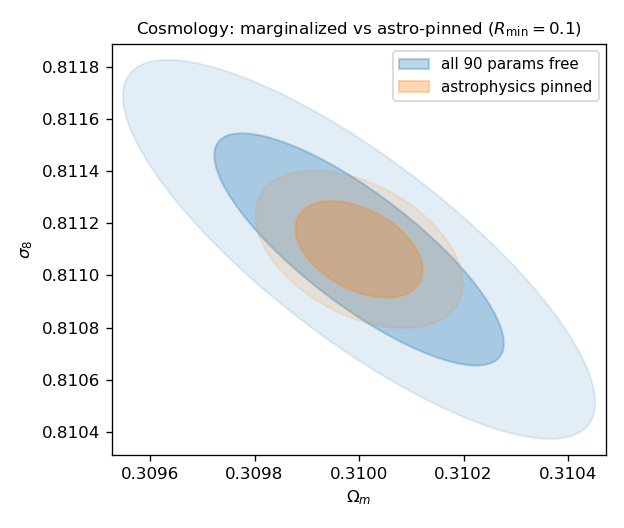
\(\Omega_m\)–\(\sigma_8\) with all 90 parameters free vs astrophysics pinned.
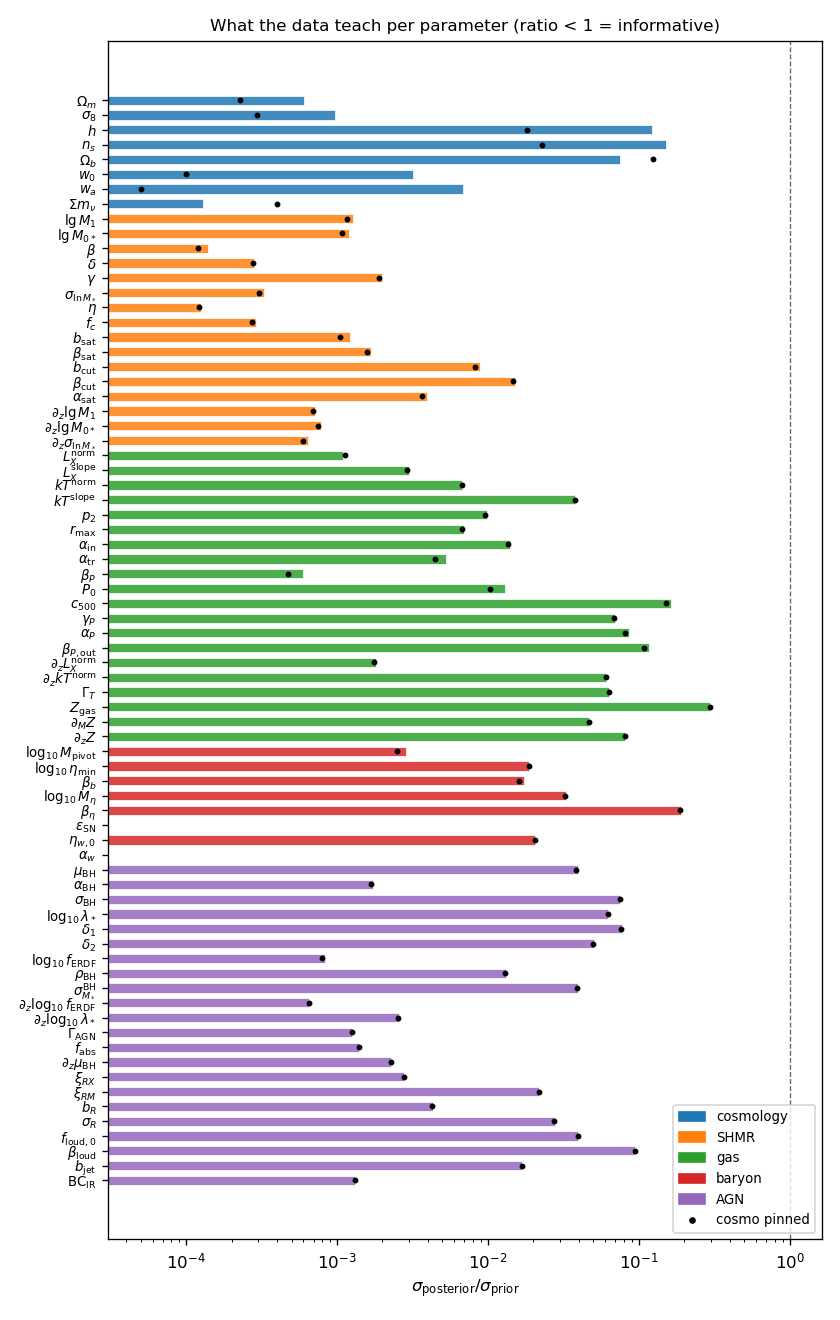
Per-parameter posterior-to-prior ratios by sector; dots show the cosmology-pinned case.
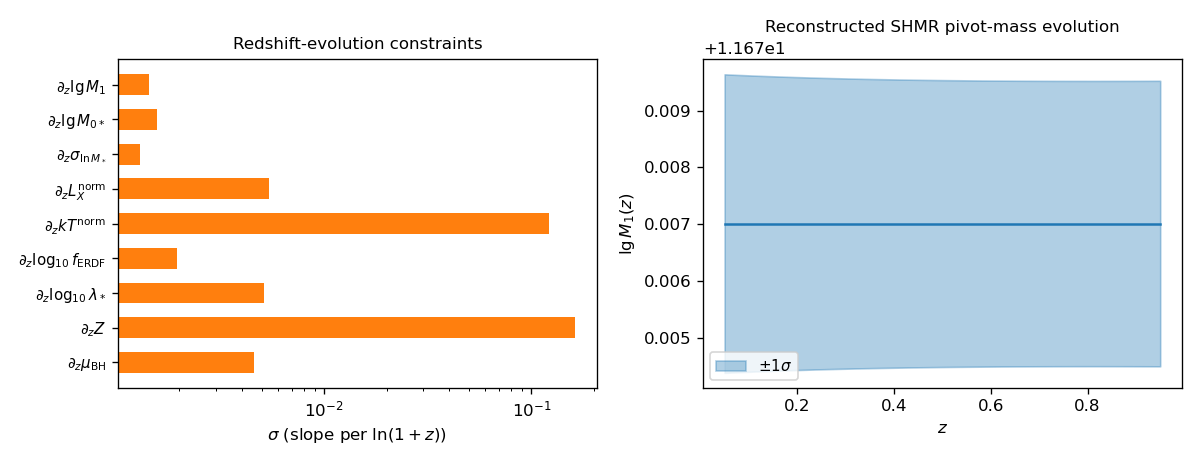
The redshift-evolution slopes — the qualitatively new tier-2 science — and the reconstructed SHMR pivot-mass evolution band (pinched at the \(z=0.3\) pivot, as it must be).
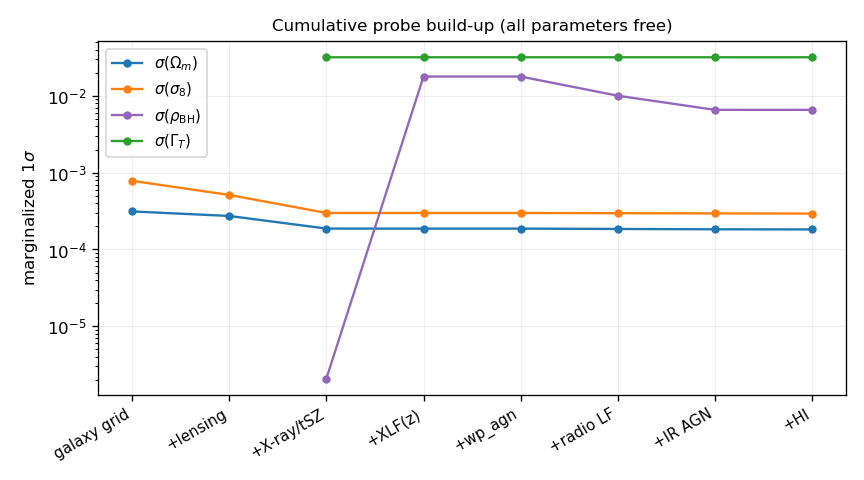
Cumulative probe build-up: galaxy grid → +shear tomography → +X-ray bands/tSZ → +XLF(z) → +AGN clustering → +radio LF → +IR AGN → +HI.
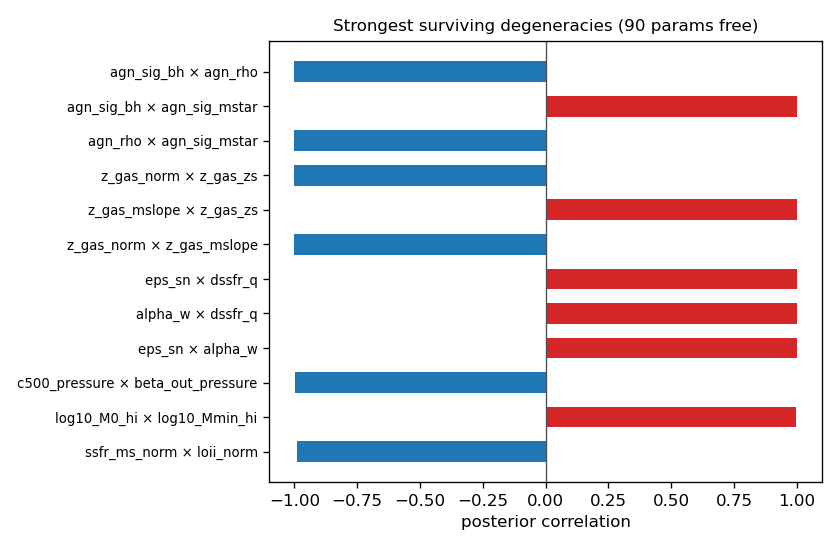
The strongest degeneracies that survive the full data combination.
Caveats
Same-shell covariance. The 8 M*-bins of one shell share large-scale modes; the diagonal treatment (with a per-cell cosmic-variance floor) is optimistic for the shell-summed constraints. A correlated-CV block is the first covariance upgrade.
Evolution-model rigidity. One \(\ln(1+z)\) slope per parameter over \(0<z<1\) can overstate the evolution constraints; quadratic slopes are a drop-in extension.
EH98 shape, growth-only extensions. \(w_0, w_a, \sum m_\nu\) are free (missing-physics extension) but enter through the CPL growth ODE only: the \(P(k)\) shape is still ΛCDM EH98, with no neutrino free-streaming suppression — so \(\sigma(\sum m_\nu)\) here reflects growth information alone and needs a differentiable \(P(k)\) upgrade to be taken at face value (Sensitivity study: differentiable pipeline, scale cuts and degeneracy breaking).
Tomographic-shear covariance is Knox-diagonal per spectrum; the full Gaussian cross-covariance among the 15 pairs is out of scope.
Fixed radial metallicity shape (DPM) and the static NH transmission template are documented approximations of the spectral layer.